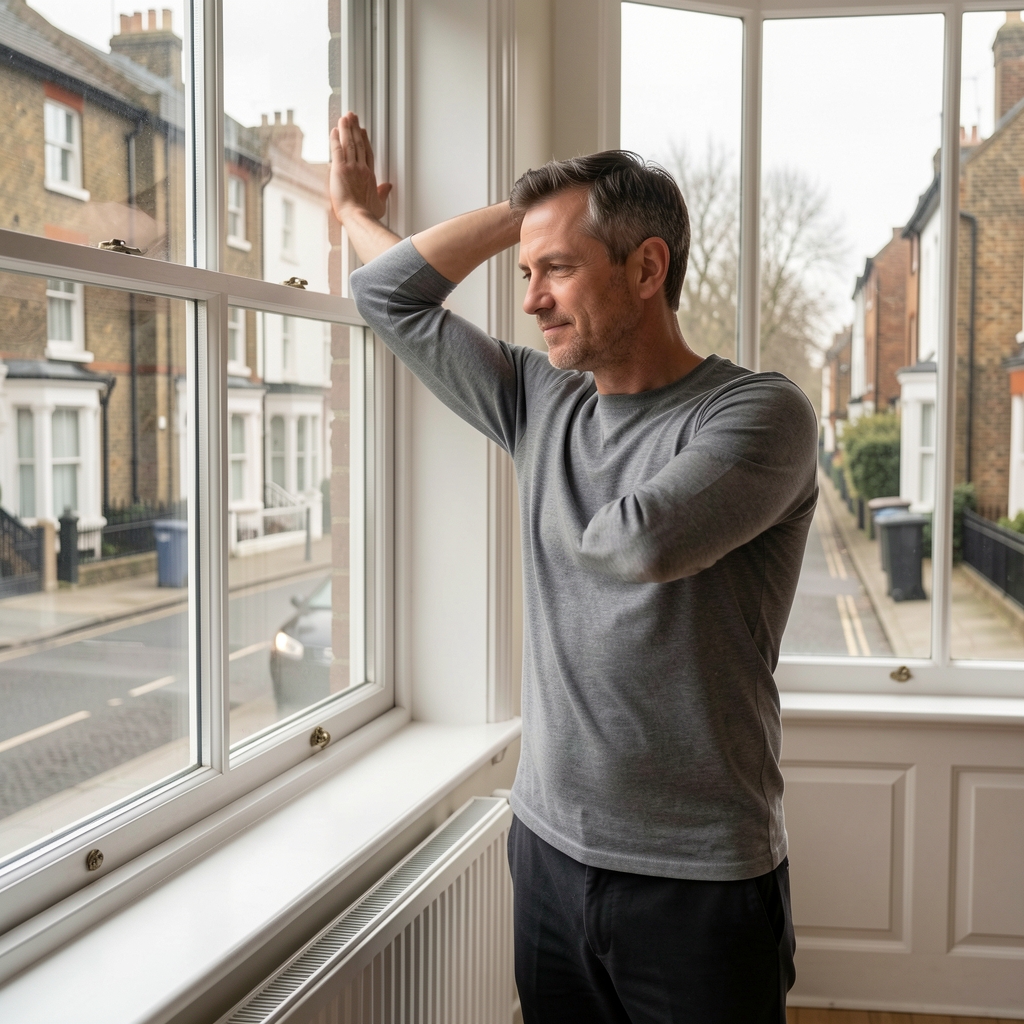
The Role of Everyday Context
Much of the discussion around pelvic floor health focuses on specific exercises — deliberate, isolated contractions of particular muscle groups. While these approaches have their own distinct value as described in exercise literature, they represent only one dimension of the picture. The daily context in which pelvic floor muscles operate — the sitting patterns, movement habits, postural tendencies and physical rhythms that make up ordinary adult life — has an equally important place in any general overview of the subject.
For men over 35 who spend significant portions of the day in sedentary work environments, the cumulative effect of habitual postures and movement patterns on the deep core musculature is a topic that physical education literature has addressed with increasing specificity in recent decades.
Sedentary Patterns and Pelvic Position
Prolonged sitting in unsupported positions is one of the most consistently cited environmental factors in contemporary movement education literature relating to core and pelvic muscular awareness. The position of the pelvis during seated work affects the resting tone and activation patterns of the surrounding musculature.
When the pelvis adopts a posterior tilt — as commonly occurs in slumped or rounded-back sitting positions — the pelvic floor muscles and deep abdominal group are placed in a mechanically disadvantaged position. The result, over extended periods, is a tendency toward reduced activation and altered habitual tension patterns.
- Chair height and depth relative to individual body dimensions influence pelvic tilt
- Desk height affects shoulder, thoracic and subsequently pelvic positioning
- Duration of uninterrupted sitting is consistently flagged in movement science as a significant variable
- Periodic standing, movement breaks or postural resets are described in workplace ergonomics literature as relevant countermeasures
Walking as a Baseline Activity
Sustained walking at a moderate pace is among the most broadly discussed general physical activities in the context of overall musculoskeletal well-being. From the perspective of pelvic floor function, walking engages the deep core system through the natural rotational and loading demands of gait — the pelvic floor activates as part of the whole-body coordination involved in each stride cycle.
Physical education literature consistently identifies regular walking as a baseline activity with wide-ranging relevance to muscular maintenance. In a pelvic floor context specifically, it contributes to circulation, functional muscle loading and postural awareness without requiring any specialised equipment or environment.
Breathing Patterns and Intra-Abdominal Pressure
The relationship between breathing mechanics and pelvic floor function is a recurring theme in contemporary movement and rehabilitation science. The diaphragm and pelvic floor are anatomically linked through the deep core pressure system — they move in coordinated response to the respiratory cycle during natural breathing.
In habitual breath-holding or upper-chest-dominant breathing patterns — which are common under conditions of sustained concentration or psychological stress — this natural coordination can become disrupted. The practical relevance of breathing awareness in physical conditioning contexts is that restoring regular, diaphragmatic breathing patterns supports the coordinated function of the entire deep core system, including the pelvic floor.
Lifting Mechanics
The mechanics of load-bearing activities — lifting, carrying, pushing — have a direct relationship to intra-abdominal pressure management, which involves the pelvic floor as one of its primary components. Physical conditioning literature distinguishes between strategies that coordinate the deep core musculature appropriately for the demands of a given load, and those that rely predominantly on breath-holding and passive loading of passive structures.
The former approach — sometimes described as active bracing or coordinated core stabilisation — involves a degree of deliberate pelvic floor and deep abdominal engagement. Physical education programmes that address lifting mechanics for general population contexts routinely include awareness of this coordination as part of foundational movement competency.
Sleep Position and Rest
While sleep position is less frequently discussed in the context of pelvic floor function than in relation to spinal alignment, there is a degree of overlap. Sustained asymmetrical lying positions can influence the resting position of the pelvis and the habitual tone of the surrounding musculature. Sleep quality and recovery are consistently identified in sports science literature as determinants of overall muscular health and tissue maintenance.
Hydration and its Context
Hydration is a standard component of any general physical well-being discussion and has contextual relevance to pelvic floor function in that it affects bladder volume and urinary frequency patterns. Physical education and general wellness literature typically notes that adequate hydration supports normal physiological function without requiring any specific pelvic floor consideration.
Caffeine and alcohol consumption, as items that affect fluid regulation, are routinely noted in educational materials covering urinary function and bladder patterns as contextual lifestyle factors — without the implication that they represent independent determinants of pelvic floor health.
This article describes general environmental and contextual factors for informational purposes. It does not provide individualised guidance on any specific situation.