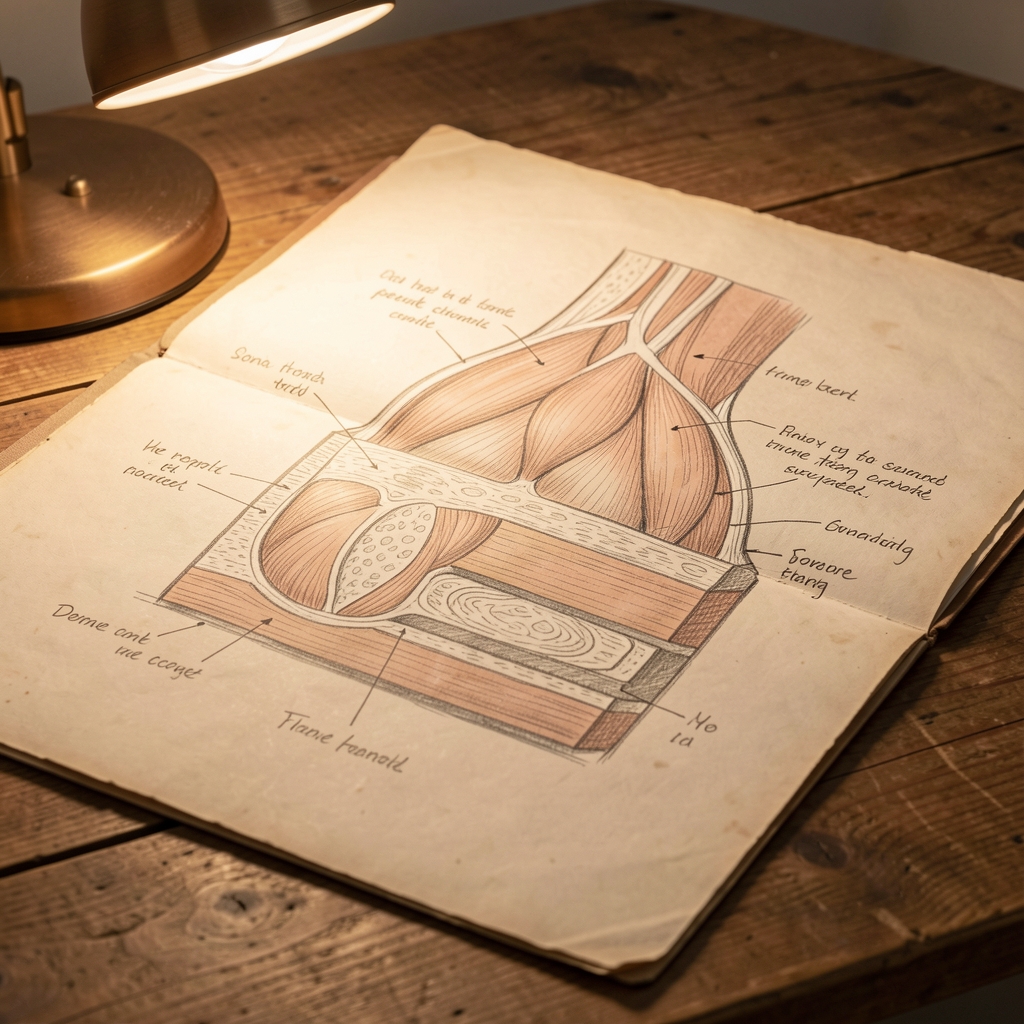
What Is the Male Pelvic Floor?
The pelvic floor is a collective term for the group of muscles, connective tissues and fascia that form the base of the pelvic cavity. In men, this structure spans the bony outlet of the pelvis, connecting the pubic symphysis at the front to the coccyx at the rear, and laterally to the ischial tuberosities — the bony prominences on which the body rests when seated.
These muscles function not as a rigid shelf but as a dynamic, responsive muscular layer. They work in coordination with other structures — the abdominal muscles, diaphragm and deep spinal extensors — as part of what anatomists and movement educators describe as the deep core unit. Understanding the pelvic floor in isolation is less informative than understanding it as one element within an interconnected system of muscular support.
Principal Muscle Groups
The pelvic floor in men is generally described as comprising two distinct functional layers, each with specific anatomical components.
The Levator Ani Group
The levator ani is the largest and most discussed component of the male pelvic floor. It is a broad, thin muscular sheet made up of three main sections:
- Pubococcygeus: Originating at the pubic bone and running posteriorly toward the coccyx, this muscle passes around the internal pelvic organs and contributes to the muscular support of the bladder and bowel. It was the specific structure highlighted in mid-20th-century anatomical research that drew attention to the pelvic floor as a distinct area of study.
- Iliococcygeus: A thinner, more lateral portion of the levator ani group, originating from the tendinous arch of the obturator fascia and inserting into the coccyx and anococcygeal ligament. It primarily contributes to the structural integrity of the pelvic floor rather than its dynamic contracting function.
- Puborectalis: A thick U-shaped bundle of muscle fibres that loops around the anorectal junction. It plays a distinctive role in continence mechanisms by maintaining the anorectal angle — a concept widely discussed in anatomical and physiological literature relating to pelvic organ function.
The Urogenital Diaphragm and Deep Perineal Muscles
In addition to the levator ani group, the pelvic floor includes a second layer sometimes referred to as the urogenital diaphragm, located more anteriorly and inferiorly. This layer contains the deep transverse perineal muscle and, in men, the external urethral sphincter — a skeletal muscle under voluntary control that surrounds the urethra below the prostate region.
The bulbospongiosus and ischiocavernosus muscles, while often categorised with the perineal muscles rather than the pelvic floor proper, are anatomically adjacent and functionally related. They are occasionally included in discussions of the pelvic floor complex in general anatomy education contexts.
Connective Tissue and Fascial Support
The musculature of the pelvic floor does not operate independently. It is embedded within and supported by an extensive network of connective tissue, including several named fascial layers and ligamentous structures.
The endopelvic fascia — a dense connective tissue layer lining the inner surface of the pelvic cavity — provides structural anchoring for the pelvic organs and transmits forces between the muscular layer and the bony pelvis. In anatomical study, this fascial system is understood as integral to overall pelvic stability, working with the muscles rather than separately from them.
The perineal body — a fibromuscular node at the centre of the perineum — serves as a convergence point for several pelvic floor muscles. Its structural integrity is considered important in anatomical accounts of pelvic floor function, as it distributes muscular forces across the base of the pelvis.
Key Terms
Nerve Supply and Proprioception
The pelvic floor muscles receive their nerve supply primarily from the pudendal nerve and direct branches of the sacral plexus (S2–S4). This dual innervation is notable: the pudendal nerve carries both motor signals for voluntary contraction and sensory feedback from the perineal region, while the sacral plexus contributions govern the more postural, tonic functions of the levator ani.
The proprioceptive capacity of the pelvic floor — its ability to sense its own position and movement — is relevant in understanding why awareness exercises are emphasised in physical education contexts that address this region. Unlike some large muscle groups that are easily consciously engaged, the pelvic floor requires deliberate attention for many individuals to accurately localise and activate.
The Pelvic Floor Within the Deep Core System
Contemporary anatomical and movement education literature frequently describes the pelvic floor as one of four key components in a pressure-regulating system sometimes called the deep core:
- The diaphragm above, providing the superior boundary
- The transversus abdominis anteriorly and laterally
- The deep multifidus muscles posteriorly
- The pelvic floor inferiorly
These structures work together to manage intra-abdominal pressure — the internal pressure generated during movement, exertion, breathing and postural changes. Understanding the pelvic floor as one element of this coordinated system provides a more complete picture of its role in general physical function than considering it in isolation.
This article presents anatomical information for general informational purposes. Content is drawn from publicly available anatomical literature and is intended to describe structures and terminology, not to provide individualised guidance.